Chinese Lyrics in Pinyin: How to Sing C-Pop Songs
Want to sing along to C-pop but can't read Chinese? Here's how pinyin works, how to pronounce Mandarin lyrics phonetically, and how to start singing your favorite Chinese songs today.
Chinese Lyrics in Pinyin: How to Sing C-Pop Songs
Pinyin is the romanization system for Mandarin Chinese — writing Chinese characters using the Latin alphabet so English speakers can pronounce them. Unlike Japanese romaji or Korean romanization, pinyin includes tone marks that show pitch changes. With pinyin, you can sing along to C-pop, Mandopop, and Chinese songs even if you have never studied the language.
That is the short answer. But if you have ever wanted to sing along to Jay Chou, G.E.M., or Chinese drama OSTs, you need to understand how pinyin works and why tones matter for singing.
This guide explains pinyin, tones, pronunciation, and how to start singing C-pop songs today.
What Most People Get Wrong About Pinyin
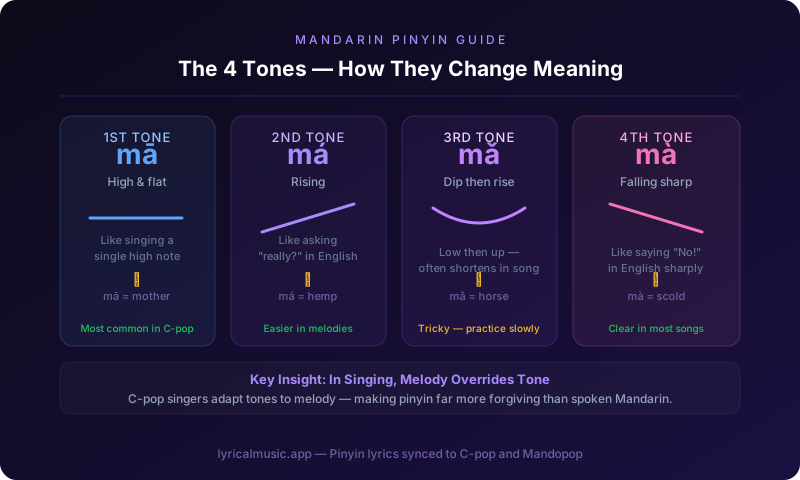
The biggest mistake is ignoring tones. In spoken Mandarin, tones change meaning. "Ma" can mean mother, hemp, horse, or scold depending on tone. But in singing, tones are more flexible. Melody overrides strict tone rules. You can sing pinyin without perfect tone accuracy and still be understood.
Another mistake is treating pinyin like English. It is not. Letters represent different sounds. "Q" sounds like "ch." "X" sounds like "sh." "C" sounds like "ts." You need to learn pinyin pronunciation rules.
The third mistake is thinking C-pop is a small genre. It is not. Mandopop is massive — Taiwan, mainland China, Singapore, Malaysia all produce C-pop. The audience is hundreds of millions. The variety is enormous.
The Counterintuitive Thing About Singing in Mandarin
Here is what surprises English speakers: Mandarin has fewer sounds than English. The syllable structure is simpler. Every syllable is one consonant (optional) + one vowel + one tone. This regularity makes pinyin more consistent than Korean or Japanese romanization.
But the tones add complexity. Mandarin has four main tones:
- First tone: High and flat (—)
- Second tone: Rising (/)
- Third tone: Dipping then rising (∨)
- Fourth tone: Falling (\)
In singing, melody often replaces strict tone pronunciation. A rising melody might override a falling tone. This makes singing more forgiving than speaking.
The emotional journey of learning pinyin: confusion at first because letters do not sound like English. Then recognition of patterns. Then successful pronunciation of a full line. Then singing along to a song and feeling the meaning even without understanding every word.
How Pinyin Works: The Basics
Initials (Consonants)
Most pinyin initials match English approximately, but some differ:
| Pinyin | Sounds Like | Example |
|---|---|---|
| q | "ch" like cheese | qi (seven) |
| x | "sh" like she | xi (west) |
| zh | "j" like judge | zhi (know) |
| ch | "ch" but with tongue curled | chi (eat) |
| sh | "sh" but with tongue curled | shi (ten) |
| r | "r" but with slight buzz | ren (person) |
| c | "ts" like cats | ci (this) |
| z | "dz" like buds | zi (word) |
Finals (Vowels)
Pinyin vowels are mostly consistent:
| Pinyin | Sounds Like | Example |
|---|---|---|
| a | "ah" like father | ma (mother) |
| o | "or" without the "r" | bo (wave) |
| e | "uh" like uh-oh | ge (song) |
| i | "ee" like see | ni (you) |
| u | "oo" like food | bu (no) |
| ü | "ee" with rounded lips | nü (woman) |
Common Combinations
- ai = "eye"
- ei = "ay" like day
- ao = "ow" like cow
- ou = "oh"
- an = "ahn"
- en = "un"
- ang = "ahng"
- eng = "ung"
Tones in Singing
In spoken Mandarin, tones are essential. In singing, melody takes priority. Here is how it works:
Melody overrides tones: If a word has a falling tone but the melody rises, you follow the melody. Native speakers understand from context.
Some tone preservation: First and fourth tones (high flat and falling) often align with musical emphasis. Second tones (rising) match ascending melodies naturally.
Do not stress about perfection: Focus on clear pronunciation of initials and finals. Tones matter less in singing than in speech.
Listen and imitate: The best way to learn is singing along with native speakers. Your ear adjusts to how tones blend with melody.
Popular C-Pop Artists to Start With
Jay Chou (周杰伦) — The king of Mandopop. Blends Chinese instruments with R&B and hip-hop. Start with "Qi Li Xiang" or "Dao Xiang."
G.E.M. (邓紫棋) — Powerful vocalist, emotional ballads. "Goodbye" or "Bubble" showcase her range.
JJ Lin (林俊杰) — Singaporean superstar. Melodic, romantic, accessible. "Jiang Nan" or "Cao Cao."
Jolin Tsai (蔡依林) — Queen of C-pop dance music. "Play" or "Dancing Diva."
Eason Chan (陈奕迅) — Hong Kong legend. Emotional depth, storytelling. "Ten Years" or "Love Transfer."
Mayday (五月天) — Taiwanese rock band. Anthemic, crowd-pleasing. "Contentment" or "Stubborn."
Hebe Tien (田馥甄) — Former S.H.E member, solo success. "A Little Happiness" (movie theme).
Using Lyrical to Sing C-Pop
Lyrical supports pinyin for Chinese songs:
Pinyin display: Chinese characters with pinyin underneath. See pronunciation while reading lyrics.
Tone indicators: Optional tone marks help you understand pitch patterns.
Real-time sync: Lyrics highlight as sung. Follow along even with unfamiliar sounds.
Word-by-word karaoke: Each syllable lights up individually. Mandarin syllable-timing becomes clear.
The specific thing Lyrical does: it makes C-pop accessible. You see pinyin, hear the song, and connect sounds to meanings in real-time.
Common Questions About Pinyin and C-Pop
Do I need to learn Chinese characters to sing C-pop?
No. Pinyin lets you pronounce Mandarin using English letters. You can sing along without knowing characters.
How important are tones in singing?
Less important than in speaking. Melody overrides strict tone rules. Focus on clear pronunciation of sounds.
Is pinyin different from other romanization systems?
Yes. Pinyin is specific to Mandarin. Cantonese uses Jyutping or Yale. Each Chinese dialect has different systems.
Can I learn Mandarin through C-pop songs?
You will pick up vocabulary and pronunciation. But C-pop lyrics are poetic, not conversational. Use songs as a supplement, not a curriculum.
What is the easiest C-pop song to learn?
"A Little Happiness" by Hebe Tien. Slow, clear, emotional. Or Jay Chou's "Qi Li Xiang" — moderate tempo, memorable melody.
Why do some letters look weird in pinyin?
Pinyin uses letters differently than English. "Q," "X," "Zh," "Ch," "Sh" represent sounds English does not have. Learn the pinyin pronunciation rules.
How long does it take to learn a C-pop song?
The chorus takes a week. A full song takes two to three weeks. Mandarin pronunciation takes practice but is consistent.
Should I learn simplified or traditional characters?
For singing, neither — use pinyin. If you later learn characters, simplified is used in mainland China, traditional in Taiwan and Hong Kong.
The Bottom Line
You can sing C-pop songs without knowing Chinese characters. Pinyin makes Mandarin pronunciation accessible. Tones matter less in singing than speaking. Start with melodic ballads, work up to faster songs, and use an app that shows pinyin synced to music.
The feeling of singing along to Jay Chou or G.E.M., pronouncing Mandarin correctly, connecting with hundreds of millions of C-pop fans? Lyrical gets you there.
Try Lyrical Free
Lyrical shows real-time synced lyrics with pinyin for C-pop, Mandopop, and more. Dynamic Island, CarPlay, and word-by-word karaoke mode included.
Download Lyrical and start singing C-pop today.
*Last updated: March 2026*