How to Sing K-Pop Songs: The Complete Beginner's Guide
Want to sing along to K-pop but don't know Korean? This guide shows you how to use romanization to sing your favorite BTS, Blackpink, and Twice songs phonetically — even if you've never studied the language.
How to Sing K-Pop Songs: The Complete Beginner's Guide
You can sing K-pop songs without knowing Korean by using romanization — phonetic spelling of Korean lyrics using English letters. With practice and the right tools, you'll go from mumbling along to confidently singing every word of your favorite BTS, Blackpink, or Twice songs.
That is the short answer. But if you are here, you probably have a specific song stuck in your head. Maybe it is the chorus of "Dynamite" that you have heard a hundred times. Maybe it is a Blackpink drop that hits different when you are driving. You want to sing along, not just hum. You want to know what sounds to make, even if you do not know what they mean.
This guide will get you there. No Korean classes required.
What Most People Get Wrong About Singing K-Pop
The biggest mistake is thinking you need to learn Korean first. You do not. Romanization exists precisely so you can pronounce Korean words without learning the alphabet. It is training wheels for your mouth.
Another mistake is trying to memorize lyrics from YouTube comment sections. Those romanizations are often wrong, inconsistently formatted, and impossible to follow while the song is playing. You need synced lyrics that scroll with the music, not static text you have to scroll yourself.
The third mistake is giving up because you sound "wrong" at first. Everyone does. Korean has sounds English does not. Your mouth literally needs to learn new muscle movements. That takes repetition, not talent.
What Is Romanization (And Why It Works)
Romanization is writing Korean words using the Latin alphabet — the same letters you use for English. Instead of seeing Korean characters like 사랑해, you see "saranghae." You read it like English. You sing it like Korean.
There are different romanization systems, but K-pop fans mostly use the Revised Romanization system. It is intuitive. "BTS" becomes "bangtan sonyeondan." "Blackpink" stays "Blackpink" because it is already English.
Here is what you need to know about reading it:
Vowels are mostly straightforward:
- "a" sounds like "ah" (father)
- "eo" sounds like "uh" (cup)
- "o" sounds like "oh" (go)
- "u" sounds like "oo" (food)
- "i" sounds like "ee" (see)
Consonants get tricky:
- "g/k" are the same letter in Korean. Context tells you which.
- "b/p" and "d/t" work the same way.
- "r/l" are one sound — softer than English "r," not quite "l."
- "ng" is a single sound, like the end of "sing."
The counterintuitive part: Korean is syllable-timed, not stress-timed like English. Every syllable gets equal weight. "Sa-rang-hae" has three beats, not two. That is why direct translation sounds robotic — you are stressing the wrong syllables.
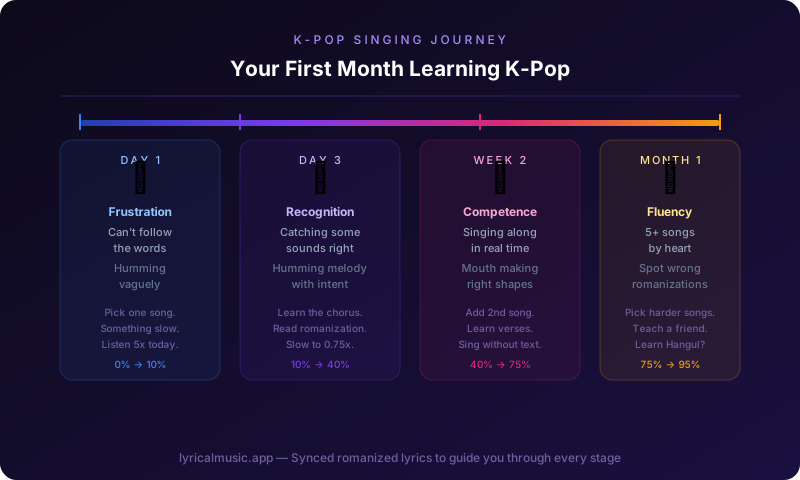
The Emotional Journey of Learning Your First Song
Day 1: You pick a song. Something slower, maybe a ballad. You find the romanized lyrics and try to follow along. It feels impossible. Your mouth cannot make those sounds that fast.
Day 3: You have listened to the song ten more times. You catch yourself humming the melody with vaguely Korean-sounding noises. This is progress. Your brain is mapping sounds to muscle memory.
Day 7: You can sing the chorus without looking at lyrics. It is not perfect. You are probably mispronouncing something. But you are singing it, and it feels good.
Day 30: You have three songs down. You notice patterns — the same words show up in different songs. "Sarang" means love. "Jebal" means please. You are not fluent, but you are not clueless either.
Day 90: You can sing along to a song you have never heard before, just by following romanized lyrics in real time. You have trained your mouth to make Korean sounds on autopilot.
The emotional arc goes from frustration to competence to confidence. Most people quit in the first week because they expect instant results. The ones who stick with it discover that singing K-pop is less about language and more about pattern recognition.
Step-by-Step: Learning Your First K-Pop Song
Step 1: Pick the right song
Start with something slower. Ballads give you time to process each syllable. "Spring Day" by BTS. "Stay" by Blackpink. "Feel Special" by Twice. Save the rap verses for later.
Step 2: Get the romanized lyrics
Do not use random websites. Use an app that syncs lyrics with the music. You need the words to highlight as they are sung, not static text you have to scroll.
Step 3: Listen without singing
Play the song once. Just listen. Notice where the singer breathes. Notice which syllables get stretched. Korean songs often hold the final vowel of a phrase.
Step 4: Sing the chorus first
Choruses repeat. They are designed to be memorable. Learn the chorus before the verses. You will get more practice per minute of effort.
Step 5: Record yourself
Your voice sounds different in your head than it does on recording. Listen back. Compare to the original. Adjust. Repeat.
Step 6: Sing along daily
Five minutes a day beats an hour once a week. Consistency builds muscle memory. Sing in the shower. Sing in the car. Sing while cooking.
What Lyrical Does Differently
Most lyrics apps give you static text. Lyrical gives you a singing coach that fits in your pocket.
Real-time sync: Words highlight as they are sung. You never lose your place.
Romanization built-in: Korean lyrics with phonetic spelling underneath. No switching between apps.
Word-by-word karaoke: Each word lights up individually so you know exactly when to sing.
Dynamic Island: Lyrics float on your screen while you use other apps. Check messages without losing your place.
CarPlay: Lyrics on your car's display. Sing along while driving (passengers only, please).
Haptic feedback: Your phone pulses with the beat. You feel the rhythm in your hand.
The specific thing Lyrical does that nothing else does: it makes romanization feel natural. You are not reading foreign text. You are singing along to your favorite songs, and the pronunciation help happens to be there when you need it.
Common Questions About Singing K-Pop
Do I need to learn Korean to sing K-pop?
No. Romanization lets you pronounce Korean words using English letters. You can sing along to hundreds of songs without knowing what the words mean. Learning Korean helps, but it is not required.
Why do I sound weird when I try to sing Korean?
Korean has sounds English does not. Your mouth needs practice making those shapes. Also, Korean is syllable-timed — every syllable gets equal emphasis. English is stress-timed — some syllables are louder and longer. You are probably stressing the wrong syllables.
What is the easiest K-pop song to sing?
Ballads are easier than rap. Songs with simple, repetitive choruses are easier than songs with complex melodies. "Spring Day" by BTS, "Stay" by Blackpink, and "Feel Special" by Twice are good starting points.
How long does it take to learn a K-pop song?
The chorus of a simple song takes a few days of practice. A full song takes one to two weeks. Fluency — being able to sing along to new songs easily — takes a few months of regular practice.
Is romanization accurate?
It is close enough for singing. Romanization captures the sounds but not the exact pronunciation nuances. Native speakers will notice differences, but you will be understandable. Think of it like singing along to a song in French without knowing French — you get the gist, even if your accent is wrong.
Can I learn Korean through K-pop?
Kind of. You will pick up common words and phrases. You will get used to Korean sounds. But K-pop lyrics are poetic, not practical. You will learn "saranghae" (I love you) before you learn how to order food. Use K-pop as a supplement, not a curriculum.
What if the lyrics app does not have my favorite song?
Most apps pull from community databases. Popular songs get added quickly. Niche songs might take longer. You can usually request additions through the app.
How do I sing the rap parts?
Slowly. Rap in K-pop is often faster than conversational Korean. Start at half speed. Use the app's slowdown feature if it has one. Focus on rhythm and flow rather than perfect pronunciation.
The Bottom Line
You can sing K-pop without knowing Korean. Romanization bridges the gap. The key is consistent practice and the right tools — synced lyrics, phonetic spelling, and patience with yourself as your mouth learns new sounds.
The 3am anxiety spiral of wanting to sing along but not knowing how? There is an app for that now.
Try Lyrical for Free
Lyrical shows real-time synced lyrics with romanization for K-pop, J-pop, and C-pop. Dynamic Island support, CarPlay integration, and word-by-word karaoke mode.
Download Lyrical and sing along to your first song today.
*Last updated: March 2026*