How to Pronounce K-Pop Words Correctly: A Fan's Guide
Want to pronounce K-pop words like a native? Here's how to say group names, common phrases, and lyrics correctly — from BTS to 'saranghae' to 'fighting.'
How to Pronounce K-Pop Words Correctly: A Fan's Guide
You can pronounce K-pop words correctly by understanding Korean sound rules: vowels are pure and consistent, consonants change based on position, and syllables get equal emphasis. Common words like 'saranghae' (I love you), 'oppa' (older brother), and 'hwaiting' (fighting/cheer) follow predictable patterns once you know the basics.
That is the short answer. But if you have ever wondered whether you are saying "BTS" correctly, or why "oppa" sounds different when different people say it, you need a guide to K-pop pronunciation.
This guide covers the most common K-pop words, group names, and phrases — how to say them and why they sound that way.
What Most Fans Get Wrong About Pronunciation
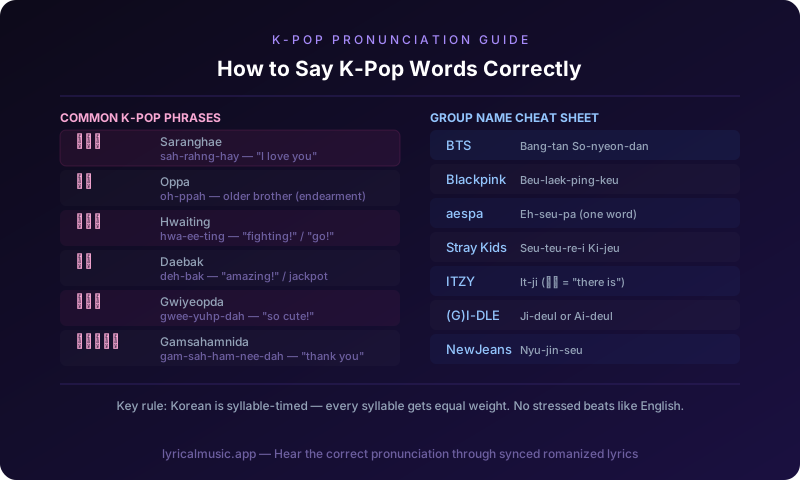
The biggest mistake is applying English pronunciation rules to Korean. Korean is syllable-timed — every syllable gets equal weight. English is stress-timed — some syllables are longer and louder. "Sa-rang-hae" has three equal beats, not two stressed beats.
Another mistake is ignoring consonant changes. Korean consonants sound different at the beginning versus end of syllables. "G" becomes "k," "b" becomes "p," "d" becomes "t" when ending a syllable.
The third mistake is not realizing romanization is imperfect. English letters approximate Korean sounds. Some Korean sounds do not exist in English. Close enough is good enough for singing along, but understanding the real sounds helps.
Group Names: How to Say Them
BTS — "Bee-tee-ess" in English, but Korean fans say "Bang-tan So-nyeon-dan" (방탄소년단). The full name means "Bulletproof Boy Scouts."
Blackpink — "Beu-laek-ping-keu" (블랙핑크). Korean adds vowels to consonant clusters. "Black" becomes "Beu-laek."
Twice — "Teu-wa-i-seu" (트와이스). The "tw" sound gets separated with a vowel.
Stray Kids — "Seu-teu-re-i ki-jeu" (스트레이 키즈). Each English sound gets Korean treatment.
NewJeans — "Nyu-jin-seu" (뉴진스). The "dj" becomes "j."
IVE — "Ai-beu-i" (아이브). Spelled out in Korean.
aespa — "Eh-seu-pa" (에스파). The "ae" is one syllable.
(G)I-DLE — "Ai-deul" (아이들) or "Ji-deul" (지들) with the G. Means "children" in Korean.
LE SSERAFIM — "Re-se-ra-fim" (르세라핌). Each syllable clear.
ITZY — "It-ji" (있지). Means "to have" or "there is" in Korean.
Common K-Pop Words and Phrases
Saranghae (사랑해) — "I love you"
- Sa-rang-hae
- "Sah-rahng-hay"
- The "eo" in "rang" is subtle — almost "sah-rahng"
Oppa (오빠) — "Older brother" (female speaker) or boyfriend
- Op-pa
- "Op-pah"
- Soft "o," sharp "p"
Unnie (언니) — "Older sister" (female speaker)
- Eon-ni
- "Un-nee"
- The "eo" at the start is barely there
Hyung (형) — "Older brother" (male speaker)
- Hyeong
- "Hyung"
- The "eo" is subtle
Noona (누나) — "Older sister" (male speaker)
- Nu-na
- "Noo-nah"
Hwaiting (화이팅) — "Fighting" / cheer
- Hwa-i-ting
- "Hwah-ee-ting"
- Koreans borrowed this from English "fighting" but pronounce it with Korean sounds
Jebal (제발) — "Please"
- Je-bal
- "Je-bahl"
Gomawo (고마워) — "Thank you" (casual)
- Go-ma-wo
- "Go-mah-woh"
Kamsahamnida (감사합니다) — "Thank you" (formal)
- Gam-sa-ham-ni-da
- "Gahm-sah-hahm-nee-dah"
Annyeong (안녕) — "Hello" or "Goodbye"
- An-nyeong
- "Ahn-nyung"
Ne (네) — "Yes"
- Ne
- "Neh"
Ani (아니) — "No"
- A-ni
- "Ah-nee"
Jinjja (진짜) — "Really"
- Jin-jja
- "Jeen-jjah"
Daebak (대박) — "Awesome" / "Jackpot"
- Dae-bak
- "Day-bahk"
Aigoo (아이구) — Exclamation of surprise, frustration, or concern
- Ai-gu
- "Eye-goo"
Pronunciation Tips
Vowels are pure: Korean vowels do not change sound like English vowels. "A" is always "ah." "I" is always "ee." "O" is always "oh."
Consonants at the end soften: "G," "b," "d" become "k," "p," "t" when ending a syllable. "Sarang" ends with "ng," not "g."
Double consonants are tense: "Kka," "tta," "ppa" require more force. The sound is sharper, not longer.
The "r/l" sound: Korean has one sound between English "r" and "l." It is softer than "r," not quite "l." "Sarang" uses this sound.
Syllables are equal: Do not stress syllables like English. "A-nnyeong" has two equal beats.
Common Mispronunciations to Avoid
"Saranghae" as "sair-ang-hay" — The "a" sounds are pure "ah," not English "air."
"Oppa" as "oh-pah" — The "o" is closer to "aw" or "oh," not English long "o."
"Hwaiting" as "fighting" — Koreans pronounce this with "hwah" at the start, not "figh."
"BTS" as individual letters in Korean — Korean fans say the full name "Bangtan Sonyeondan" or "Bang-tan."
Adding English stress — "Sa-RANG-hae" stresses the wrong syllable. All syllables are equal: "Sa-rang-hae."
Using Lyrical to Improve Pronunciation
Lyrical helps you pronounce K-pop words correctly:
Romanization with audio: See spelling while hearing native pronunciation. Connect sounds to letters.
Word-by-word highlighting: Each syllable lights up as sung. Learn the rhythm of Korean speech.
Repeat and practice: Loop difficult words until they feel natural. Muscle memory develops with repetition.
Compare to original: Sing along with the artist, then listen back to yourself. Adjust until they match.
The specific thing Lyrical does: it makes correct pronunciation achievable. You see, hear, and practice simultaneously.
Common Questions About K-Pop Pronunciation
Do I need perfect pronunciation to sing K-pop?
No. Close enough is good enough for enjoyment. Native speakers will understand you. Perfect pronunciation comes with time and practice.
Why do English speakers struggle with Korean sounds?
Korean has sounds English does not have. The "r/l" sound, tense consonants, and pure vowels require practice. Your mouth needs to learn new shapes.
Is romanization accurate?
Approximately. Romanization captures sounds roughly but not perfectly. Listening to native speakers is essential.
Should I learn Hangul instead of using romanization?
Eventually, yes. Hangul is the Korean alphabet. It is phonetic and consistent. You can learn it in a few days. But romanization gets you singing immediately.
Why do group names sound different in Korean?
Korean adds vowels to consonant clusters. English "Black" becomes Korean "Beu-laek." This is how Korean phonology works.
How long until my pronunciation sounds natural?
Months of regular practice. Do not rush. Focus on enjoyment first, perfection later.
Can I use these pronunciations in Korea?
Yes. Koreans appreciate effort. Your pronunciation does not need to be perfect to be understood and appreciated.
What is the most important word to pronounce correctly?
"Saranghae" — "I love you." Used constantly in K-pop and K-dramas. Worth getting right.
The Bottom Line
You can pronounce K-pop words correctly with practice. Understand Korean sound rules: pure vowels, consonant changes, equal syllable weight. Use romanization as a guide, listen to native speakers, and practice regularly.
The confidence of saying "saranghae" correctly, pronouncing group names like a fan, singing along without embarrassment? Lyrical helps you get there.
Try Lyrical Free
Lyrical shows real-time synced lyrics with romanization for K-pop, J-pop, and C-pop. Perfect for learning correct pronunciation while singing along.
Download Lyrical and pronounce K-pop words like a pro.
*Last updated: March 2026*