What Is Romanization? How to Read K-Pop Lyrics Phonetically
Romanization turns Korean lyrics into English letters so you can sing along without learning the Korean alphabet. Here's how to read it, pronounce it, and use it to sing your favorite K-pop songs.
What Is Romanization? How to Read K-Pop Lyrics Phonetically
Romanization is the practice of writing Korean words using the Latin alphabet — the same letters used for English. It lets you pronounce Korean lyrics phonetically without learning the Korean alphabet. With romanization, "사랑해" becomes "saranghae," and you can sing along even if you have never studied Korean.
That is the short answer. But if you are staring at romanized lyrics and wondering why nothing sounds right when you say it, you need to understand how romanization actually works. It is not perfect. It is a bridge, not a destination.
This guide explains what romanization is, how to read it, why it sometimes feels wrong, and how to use it to sing K-pop songs.
What Most People Get Wrong About Romanization
The biggest mistake is treating romanization like English. It is not. The letters represent Korean sounds, not English ones. "J" in Korean is softer than "J" in "jump." "R" is not quite "R" or "L" — it is something in between.
Another mistake is expecting perfect accuracy. Romanization is an approximation. Korean has sounds English does not have. English has sounds Korean does not have. The mapping is close enough for communication, not exact enough for linguistics.
The third mistake is learning romanization instead of Korean. Romanization is training wheels. It helps you sing along now. It does not teach you the language. If you want to actually learn Korean, you need to learn Hangul — the Korean alphabet.
The Counterintuitive Thing About Romanization
Here is what surprises people: there are multiple romanization systems, and they disagree with each other. The same Korean word might be spelled three different ways depending on which system you use.
Revised Romanization is the official South Korean system. It is what you see on street signs and government documents. It prioritizes consistency over pronunciation accuracy.
McCune-Reischauer is the older system. You still see it in academic contexts and some older K-pop romanizations.
K-pop fan romanization is the wild west. Fans write what they hear, not what is technically correct. "Oppa" instead of "oppa." "Unnie" instead of "eonni." These spellings stick because they capture how the word actually sounds, not how linguists think it should be spelled.
The emotional journey of a K-pop fan: you learn one spelling, then see a different spelling somewhere else, then wonder if you have been saying it wrong the whole time. You probably have not. Different sources just use different systems.
How to Read Romanization: The Basics
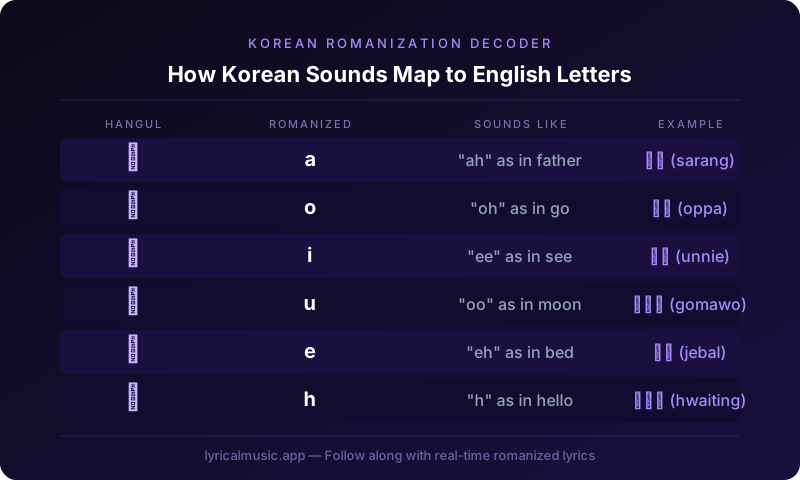
Vowels
Korean has simple vowels and complex vowels. Here is what they sound like:
| Romanization | Sounds Like | Example |
|---|---|---|
| a | "ah" like father | sarang (love) |
| eo | "uh" like cup | eolgul (face) |
| o | "oh" like go | oppa (older brother) |
| u | "oo" like food | unnie (older sister) |
| eu | "eu" like put (but lips relaxed) | eunha (galaxy) |
| i | "ee" like see | sikdang (restaurant) |
| ae | "eh" like met | maenal (every day) |
| e | "eh" like met (slightly different) | sone (in hand) |
Complex vowels combine these:
- ya = yah
- yeo = yuh
- yo = yoh
- yu = yoo
- wa = wah
- wo = woh
- wi = wee
Consonants
This is where romanization gets messy. Korean consonants change based on where they appear in a word. The same letter sounds different at the beginning versus the end.
The basics:
| Romanization | Position | Sounds Like |
|---|---|---|
| g/k | Start of word | "g" like go |
| g/k | Middle/end | "k" like king |
| b/p | Start of word | "b" like boy |
| b/p | Middle/end | "p" like pop |
| d/t | Start of word | "d" like dog |
| d/t | Middle/end | "t" like top |
| r/l | Start of word | "r" (soft, almost "l") |
| r/l | Middle/end | "l" like love |
| n | Anywhere | "n" like no |
| m | Anywhere | "m" like mom |
| s | Anywhere | "s" like so |
| j | Anywhere | "j" like jam (softer) |
| ch | Anywhere | "ch" like chat |
| k | Anywhere | "k" like king (aspirated) |
| t | Anywhere | "t" like top (aspirated) |
| p | Anywhere | "p" like pop (aspirated) |
| ng | End of syllable | "ng" like sing |
The aspirated consonants (k, t, p, ch) have more air behind them. You can feel it if you hold your hand in front of your mouth.
Double Consonants
Korean has tense consonants that romanization shows by doubling the letter:
- kk = sharp "k"
- tt = sharp "t"
- pp = sharp "p"
- ss = sharp "s"
- jj = sharp "j"
These are harder, more forceful versions of the regular consonants. "Kkae" (break) sounds different from "gae" (dog).
Common Romanization Patterns in K-Pop
Saranghae (I love you)
- Sa-rang-hae
- "Sah-rahng-hay"
- The "eo" in "rang" is subtle — almost like "rahng"
Gomawo (Thank you)
- Go-ma-wo
- "Go-mah-woh"
- The "wo" at the end is one syllable, not two
Jebal (Please)
- Je-bal
- "Je-bahl"
- The "j" is soft — almost like "ch" but voiced
Oppa (Older brother, boyfriend)
- Op-pa
- "Op-pah"
- The double "p" is pronounced as a single sharp "p"
Unnie (Older sister)
- Un-nie
- "Un-nee"
- The "eo" at the start is barely there — starts with the "n" sound
Hwaiting (Fighting/cheer)
- Hwa-i-ting
- "Hwah-ee-ting"
- Koreans borrowed this from English "fighting" but pronounce it with Korean sounds
The Emotional Journey of Learning Romanization
Week 1: Everything looks wrong. You say "saranghae" and it sounds nothing like the song. You are stressing the wrong syllables and pronouncing vowels like English.
Week 2: You start hearing the patterns. Every time you see "eo" you remember to say "uh." The consonants at the end of words soften. You are getting closer.
Week 3: You can read romanization without thinking about it. Your mouth makes the right shapes automatically. You still sound foreign, but you are understandable.
Month 3: You notice when romanization is wrong. You see "oppa" spelled "opa" and it looks weird. You have internalized the patterns.
The counterintuitive part: the goal is not perfect pronunciation. The goal is singing along confidently. Romanization gets you 80% of the way there. That is enough for most fans.
What Lyrical Does Differently
Most lyrics apps show you Korean characters or English translations. Lyrical shows you both — Korean text with romanization underneath, synced to the music in real time.
Real-time sync: The romanization highlights word by word as the song plays. You never lose your place.
Visual separation: Korean characters on top, romanization below. Your eye learns to associate the shapes with the sounds.
Consistency: Lyrical uses the same romanization system across all songs. You are not switching between McCune-Reischauer and fan romanization mid-album.
The specific thing Lyrical does that nothing else does: it makes romanization feel like a natural part of the lyrics, not an afterthought. You are not reading a separate text. You are reading the lyrics, and the pronunciation help is just there.
Common Questions About Romanization
Is romanization the same as translation?
No. Romanization shows pronunciation. Translation shows meaning. "Saranghae" romanized is "saranghae." Translated it is "I love you." Lyrical can show both — romanization for singing, translation for understanding.
Why does the same word have different spellings?
Different romanization systems. Also, fan spellings often prioritize sounding right over being technically correct. "Oppa" and "oppa" are the same word spelled different ways.
Should I learn Hangul instead of using romanization?
Eventually, yes. Hangul is actually easy to learn — you can master it in a few days. But romanization lets you sing along immediately while you decide if you want to commit to learning the language.
Why do some letters not sound like I expect?
Korean sounds do not map perfectly to English letters. "R" in Korean is not English "R." It is a sound between "R" and "L" that English does not have. Romanization does the best it can with the letters available.
Can I learn Korean just from romanization?
No. Romanization teaches pronunciation, not grammar or vocabulary. You will pick up common words and phrases, but you will not become fluent. Use romanization to sing along. Use proper Korean lessons to learn the language.
Why do some words look nothing like they sound?
Korean spelling rules are different from English. Sounds change based on what comes before and after them. Romanization tries to show the actual pronunciation, but sometimes the spelling reflects the underlying Korean structure, not the sound.
Is romanization different for Japanese and Chinese?
Yes. Japanese uses romaji, which is simpler because Japanese sounds map to English letters more cleanly. Chinese uses pinyin, which has its own rules and tone marks. Lyrical handles all three with appropriate systems for each.
The Bottom Line
Romanization is a bridge. It lets you sing K-pop songs without learning Korean first. It is not perfect, but it is good enough. The letters give you approximate pronunciation. Your ear and repetition fill in the gaps.
The 3am spiral of wanting to sing along but not knowing how? Romanization is the answer. Find an app that shows it synced to the music. Start with simple songs. Practice daily. In a month you will be singing along to songs you never thought you could.
Try Lyrical Free
Lyrical shows real-time synced lyrics with romanization for Korean, Japanese, and Chinese. Korean characters on top, phonetic spelling below, word-by-word highlighting.
Download Lyrical and start reading romanization like a pro.
*Last updated: March 2026*